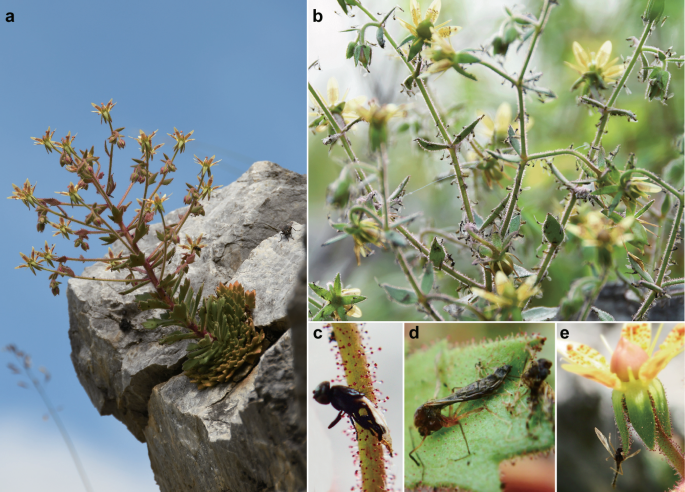
Sticky hairs covered with insects are not enough to call a plant carnivorous. A Nature Communications paper published on 4 August 2026 tested Saxifraga candelabrum across the full functional sequence of attraction, capture, digestion and prey-derived nutrient uptake.

Field observations and herbarium specimens show persistent prey capture
Mature plants trapped many small insects on glandular hairs. In herbarium material collected from 1888 to 2016, insects were still present on 43 of 45 flowering specimens, arguing against a one-time accidental observation.
The plant attracts insects and has digestive-enzyme activity
Experiments separating visual and volatile cues showed that odor contributed to insect visitation. ELF97 assays detected phosphatase activity in glandular tissues, with non-carnivorous relatives used as controls.
15N-labelled prey provided the decisive nutrient-transfer test
The researchers fed plants Drosophila enriched in 15N and measured the isotope in plant tissues two weeks later. They excluded the prey-contact tissue from the assay and evaluated soil as an alternative route. The movement of prey-derived nitrogen into the plant is therefore evidence for nutrient acquisition, not merely capture.
Comparative genomics suggests convergent evolutionary routes
A chromosome-level genome and comparisons across independently evolved carnivorous lineages identified convergence in genes associated with leaf morphology, digestion and nutrition. Those associations are evolutionary candidates rather than complete functional proof for every gene.
The study is valuable not only for identifying carnivory in Saxifraga, but also for showing how to build evidence for the statement that a plant truly ‘eats’ an animal.
For related context, see Pollen Species Change Honey-Bee Metabolism: Six Monodiets Altered Fat Body and Energy Reserves.
For related context, see The 4.83-Gb Ophrys sphegodes Genome Links Sexual Deception to Odor-Gene Duplications and an LTR Burst.
For related context, see Inside the Red-Snow Alga Sanguina nivaloides: 3D Imaging of a Non-Cultivable Snow-Algal Cyst.
Reference
- Zhang X-J et al. Identification of carnivory in the flowering plant Saxifraga via multidisciplinary evidence. Nature Communications. 2026;17:7557. https://doi.org/10.1038/s41467-026-75288-y

Comments