
Surveying tropical forest canopies is difficult and expensive. A 2025 Science Advances study used environmental DNA washed from canopy leaves by rainfall and collected it with low-cost passive samplers to detect plants, vertebrates and insects.
Umbrella-like collectors integrated canopy rainwash
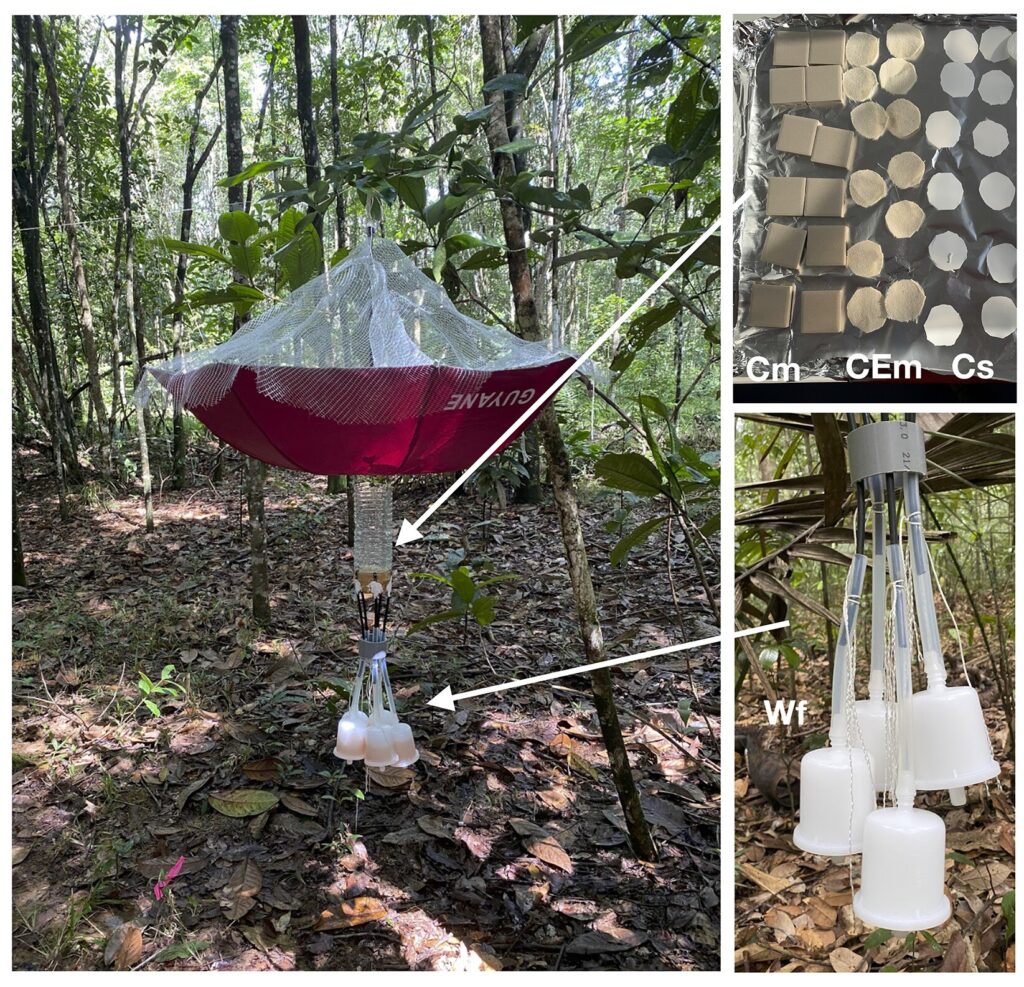
Collectors were deployed in an old-growth Amazonian forest in French Guiana and a nearby tree plantation. Four passive sampling materials were compared. A carrot-juice spike applied to canopy leaves was used to estimate persistence: carrot eDNA was modeled to decline to 5% of its initial quantity after about 29 days.
Old-growth forest yielded 1.3–1.9× higher taxonomic diversity
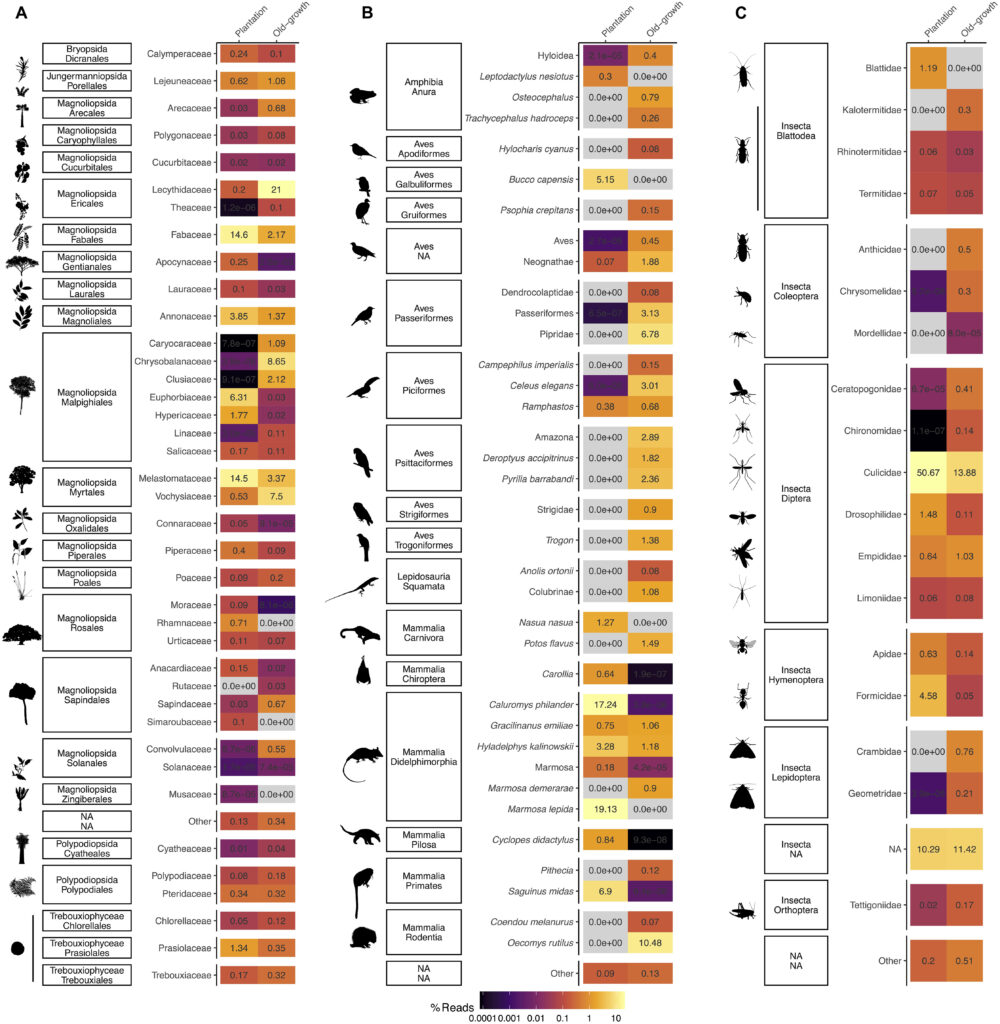
Assignments in old-growth forest included 155 plant taxa versus 111 in the plantation, 61 vertebrates versus 32, and 276 insects versus 153. Overall taxonomic diversity was 1.3–1.9 times higher in old growth.
These are eDNA taxonomic assignments, not a complete census. Reference-database gaps and marker resolution can produce misassignments, and the paper explicitly documents some local taxa assigned to related nonlocal species.
Spatial sampling retained localized signals
Collectors placed every 20 m for 40 days showed spatial turnover in plant and insect communities, supporting relatively local canopy signatures. Vertebrate signal was insufficient for that spatial analysis, highlighting taxon-specific limits.
Rainwash eDNA therefore complements rather than replaces direct ecological survey, while offering a low-cost non-invasive route to repeated canopy biodiversity monitoring.
For related context, see Predicting Individual Chinese Cabbage Weight by Drone: R² > 0.72 Even 53 Days Before Harvest.
For related context, see LZUPSD: 4,496 Smartphone Images Covering 88 Seed Categories for Fine-Grained Recognition.
For related context, see Inside the Red-Snow Alga Sanguina nivaloides: 3D Imaging of a Non-Cultivable Snow-Algal Cyst.
Reference
- Zinger L et al. Elusive tropical forest canopy diversity revealed through environmental DNA contained in rainwater. Science Advances. 2025;11:eadx4909. https://doi.org/10.1126/sciadv.adx4909

Comments