Wheat geneticists have used four names for a major source of resistance to stripe, or yellow, rust: Yr26, Yr24, YrCH42 and YrG22.
A study published in Nature Communications on August 24, 2026, now places those names under one molecular identity. By cloning Yr26 and validating its function, the authors identify Yr24, YrCH42 and YrG22 as synonyms of the same resistance gene.
That is interesting for a reason that goes beyond wheat pathology.
In classical plant genetics, genes often receive names before their DNA sequence is known. A resistance phenotype may be discovered in one accession, mapped to a chromosome and given a symbol. Another research group may later find a similar phenotype in different germplasm and give it another name. Only years later, after finer mapping, allelism tests and ultimately gene cloning, can researchers determine whether the names refer to different genes, different alleles or the same molecular gene.
Yr26 is a particularly clear example of that process.
And the molecular identity is itself unusual: Yr26 does not encode a canonical NLR immune receptor. It encodes a newly evolved transmembrane protein, with a C-terminal four-helical bundle implicated in Ca²⁺-dependent cell death.
This article follows both stories: how four historical gene names converged on one molecular gene, and what that gene appears to do in wheat immunity.
- What is wheat stripe rust?
- Genes can have names before they have molecular identities
- Yr24 and Yr26 were suspected to be the same gene long ago
- Chuanmai 42 added the name YrCH42
- In 2026, YrG22 joined the same molecular identity
- Is it common for one gene to have several names?
- Yr26 was not a canonical NLR resistance gene
- Silencing, mutation and complementation established function
- A C-terminal four-helical bundle and Ca²⁺-dependent cell death
- Yr26 appears to have arisen in emmer wheat and moved into bread wheat
- Unifying names is not mere bookkeeping
- Yr26 is not a stand-alone solution
- The names of genes carry the history of how they were discovered
- References
What is wheat stripe rust?
Stripe rust, also called yellow rust, is caused by the obligate biotrophic fungus Puccinia striiformis f. sp. tritici (Pst).
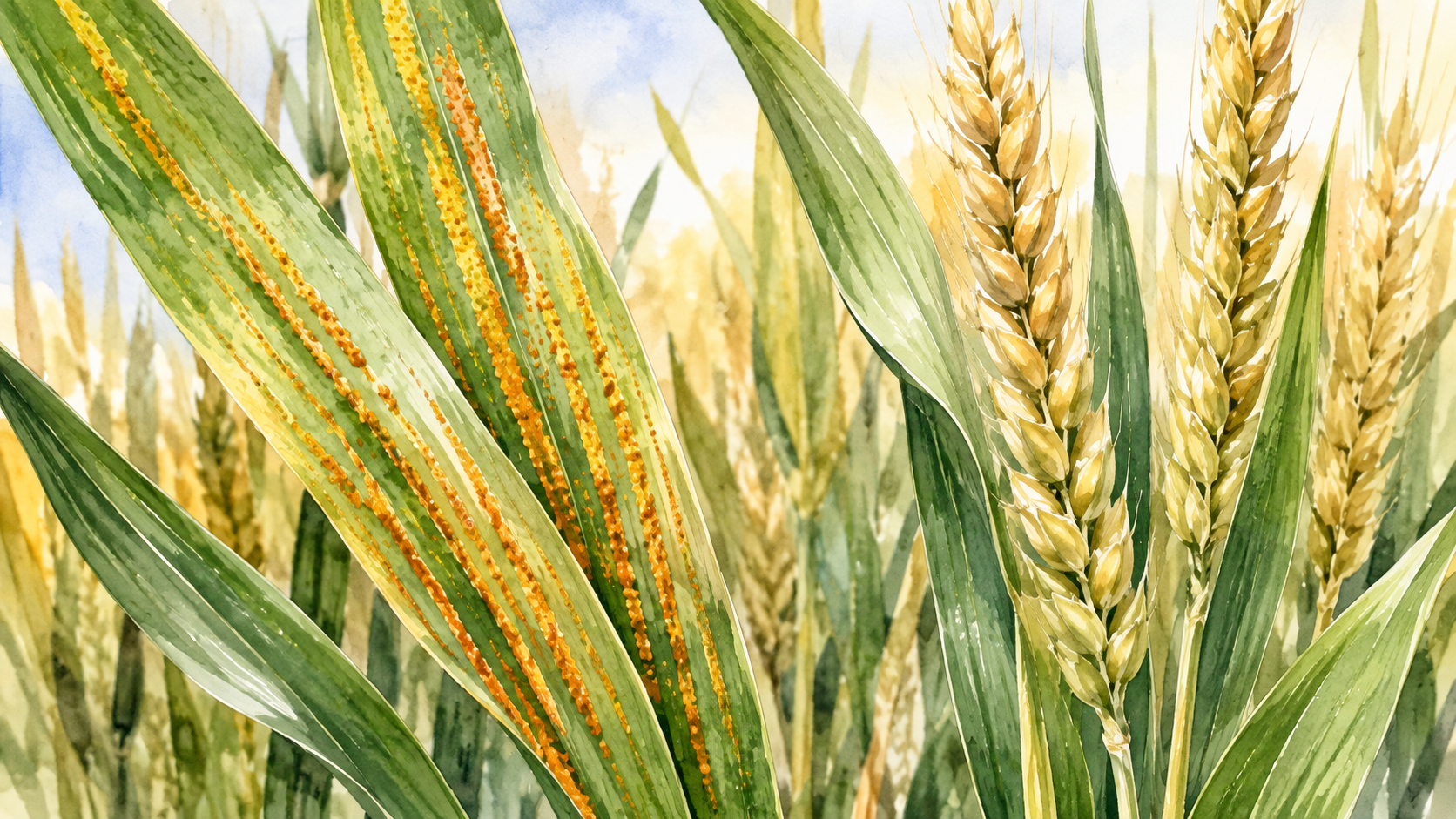
Infected wheat leaves develop yellow to orange uredinial pustules arranged in characteristic stripes along the leaf. Under favorable conditions, the pathogen can spread rapidly across wheat-growing regions, which is why genetic resistance has been a major breeding target for decades.
Wheat genes that confer resistance to yellow rust are conventionally given Yr symbols.
Examples include Yr5, Yr10, Yr15, Yr18 and Yr26.
But many of these names were created before the underlying DNA sequence had been cloned.
Genes can have names before they have molecular identities
Classical gene discovery begins with phenotype and segregation.
A resistant wheat line is crossed with a susceptible one. If the progeny segregate in a pattern consistent with a single dominant resistance factor, researchers can map that factor using genetic markers. If it appears different from known genes, a new Yr designation or temporary name may be assigned.
At that stage, however, the strongest statement may still be only:
“A genetic factor controlling resistance lies somewhere in this chromosomal interval.”
Without cloning the causal sequence, it can be difficult to distinguish a nearby independent gene from a new allele of a known gene, or from the same resistance gene that has entered a different breeding lineage.
Wheat makes this especially challenging. Bread wheat is hexaploid, its genome is large and repetitive, and recombination is low around centromeric regions. Historical linkage maps therefore did not always have enough resolution to settle gene identity cleanly.
Yr24 and Yr26 were suspected to be the same gene long ago
The 2026 paper did not suddenly collapse four completely unrelated genes into one.
Yr24 and Yr26 had already been suspected to represent the same resistance source for many years.
Yr24 was identified in durum-wheat material, while Yr26 was characterized from Triticum turgidum-derived resistance used extensively in Chinese breeding. Both mapped to the same broad region of chromosome 1B and showed similar pathogen-response spectra.
This is why older literature frequently refers to Yr24/Yr26 together.
A 2018 retrospective review by Robert McIntosh and colleagues is especially revealing. The authors reconstructed the history of this locus and noted that researchers had initially assumed that at least three resistance genes existed at or near the region, creating an erroneous impression of resistance diversity.
In other words, the confusion itself became part of the history of the gene.
Chuanmai 42 added the name YrCH42
The Chinese wheat cultivar Chuanmai 42 carried strong stripe-rust resistance.
A 2006 mapping study showed that the resistance behaved as a single dominant gene near the centromeric region of chromosome 1B and temporarily named it YrCH42.
Importantly, the same study performed allelism tests against Yr24 and Yr26 and compared reactions against 26 Pst isolates.
The conclusion was already that YrCH42, Yr24 and Yr26 were likely to be the same gene.
But “likely the same by genetics” is not identical to “the same molecular gene has been cloned and functionally demonstrated.”
The latter requires identifying the causal sequence and showing that manipulating that sequence changes resistance.
In 2026, YrG22 joined the same molecular identity
The 2026 study by Liu and colleagues used map-based cloning to isolate Yr26.
In the paper, Yr24, YrCH42 and YrG22 are explicitly listed as synonyms of Yr26.
At the molecular level, the four historical designations can therefore be summarized as:
Yr26 = Yr24 = YrCH42 = YrG22
A qualification is useful here. “The same gene” does not necessarily mean that every accession carrying these names must have an absolutely identical nucleotide sequence across the entire locus. The key point is that the historical resistance designations converge on the same molecular gene identity/locus, rather than representing four independent resistance mechanisms.
That distinction matters enormously in germplasm management and breeding.
Four names can look like four sources of resistance. If they are molecularly the same gene, they cannot be counted as four independent defense systems.
Is it common for one gene to have several names?
It is not unusual, particularly for crop traits studied for decades before cloning became routine.
But there are at least two different reasons this can happen.
Route 1: independent discovery in different germplasm
Yr26/Yr24/YrCH42/YrG22 illustrates this route.
Similar resistance was identified in different wheat materials and accumulated different names through separate genetic and breeding histories. Mapping and allelism gradually suggested identity, and molecular cloning eventually unified the names.
This is not a case of four related genes evolving the same function. It is a case in which one resistance source was seen through several historical names.
Route 2: one pleiotropic gene receives phenotype-specific names
A classic wheat example is Lr34.
The same molecular gene has historically been called:
- Lr34 for leaf-rust resistance
- Yr18 for stripe-rust resistance
- Sr57 for stem-rust resistance
- Pm38 for powdery-mildew resistance
Cloning and mutant analysis showed that these resistance phenotypes arise from the same ABC-transporter gene.
Other wheat examples include Lr67/Yr46/Sr55/Pm46 and Lr46/Yr29/Sr58/Pm39.
This is conceptually different from Yr26. The multiple names of Lr34 reflect different pathogen-resistance phenotypes of one pleiotropic gene, whereas the Yr26 names mainly reflect independent discovery and naming histories around the same stripe-rust resistance locus.
Both cases show how phenotype-first genetics can later be reorganized by molecular biology.
Yr26 was not a canonical NLR resistance gene
The identity of Yr26 is also biologically interesting.
Many major plant disease-resistance genes encode intracellular NLR receptors. But the cloned Yr26 gene encodes a transmembrane protein and is described by the authors as a newly evolved gene in the Triticeae lineage.
Earlier fine-mapping work had already made Yr26 puzzling. The mapped interval did not contain an obvious canonical resistance-gene candidate, making the locus difficult to resolve by expectation alone.
The final gene therefore expands the range of protein architectures that can underlie major disease resistance in wheat.
Silencing, mutation and complementation established function
The study did more than identify a sequence that co-segregated with resistance.
Yr26 was tested using multiple functional approaches, including:
- gene silencing
- mutation analysis
- transgenic complementation
Together, these experiments connect the cloned sequence directly to the resistance phenotype. Disrupting Yr26 compromises resistance, while complementation or appropriate transgenic expression restores or confers the relevant function.
That is what turns a mapped candidate into the causal resistance gene.
A C-terminal four-helical bundle and Ca²⁺-dependent cell death
AlphaFold 3 predicts a four-helical bundle at the C terminus of Yr26.
The 2026 study reports that this region is important for triggering cell death, and that Yr26-associated cell death depends on Ca²⁺.
Rapid changes in cytosolic Ca²⁺ are among the earliest signals in plant immunity. Strong immune activation can also trigger the hypersensitive response, in which cells around an infection site die rapidly and restrict the spread of a biotrophic pathogen.
The results therefore link the transmembrane architecture of Yr26, its C-terminal helical region and Ca²⁺-dependent cell death to the resistance phenotype.
However, the complete recognition mechanism remains unresolved. The study does not yet establish exactly which Pst molecule is perceived, whether Yr26 acts alone or in a complex, or precisely how it initiates Ca²⁺ signaling.
Yr26 appears to have arisen in emmer wheat and moved into bread wheat
The evolutionary analysis adds another layer.
The authors infer that Yr26 first arose in emmer wheat and was introduced relatively recently into bread wheat.
Emmer wheats carry AABB genomes and occupy a central position in the ancestry of modern wheats. Their genetic diversity has repeatedly supplied useful alleles to breeding programs.
Yr26 is therefore an example of a relatively new defense gene arising in an ancestral tetraploid wheat lineage and later entering bread-wheat breeding material.
This makes the locus relevant not only to disease resistance but also to the study of how new immune genes arise, spread and are eventually challenged by pathogen evolution.
Unifying names is not mere bookkeeping
At first glance, learning that Yr26, Yr24, YrCH42 and YrG22 are the same gene sounds like nomenclature cleanup.
For breeding, it is more important than that.
One strategy for improving durability is gene pyramiding—combining multiple resistance genes in one cultivar.
But the value of a pyramid depends on combining genuinely independent resistance mechanisms.
If two differently named resistance sources are actually the same molecular gene, counting both would overestimate the genetic diversity of the stack.
Once the causal gene is cloned, breeders can move from indirect linked-marker inference toward gene-specific sequence assays and make cleaner decisions about which resistance components are genuinely distinct.
Yr26 is not a stand-alone solution
The cloning of Yr26 does not mean that the yellow-rust problem has been solved.
Yr26 was used extensively in Chinese wheat breeding, but Pst populations capable of overcoming Yr26 subsequently emerged.
The 2018 Yr24/Yr26 retrospective review described this history as a classic boom-and-bust cycle: a major resistance gene becomes widespread, pathogen populations experience strong selection to overcome it, and virulent races eventually erode its effectiveness.
The present value of Yr26 is therefore best viewed as:
- a sequence-defined resistance component
- a tool for rational resistance-gene pyramids
- a model for host–pathogen co-evolution
- an example of a noncanonical immune protein
rather than as a universal single-gene solution.
The names of genes carry the history of how they were discovered
The 2026 cloning study consolidates Yr24, YrCH42 and YrG22 under Yr26 and provides functional evidence for the molecular gene behind those historical resistance names.
The identity had been suspected for years from mapping, pathogen-response patterns and allelism tests. Cloning now turns that genetic suspicion into a molecularly defined framework.
The gene itself adds another surprise: it is a newly evolved transmembrane protein rather than a canonical NLR, and its C-terminal region is linked to Ca²⁺-dependent cell death.
Plant genetics often begins with phenotype. Names can therefore appear before the underlying molecule is known.
Later, DNA sequence and functional experiments reorganize that history.
Four genes did not suddenly become one. Four names were finally traced back to one molecular identity.
That is what makes Yr26 an interesting story not only in plant pathology, but in genetics itself.
References
Liu S, Mu K, Yang S, et al. A transmembrane protein confers the Yr26/Yr24/YrCH42/YrG22-mediated stripe rust resistance in wheat. Nature Communications. Published 24 August 2026. DOI: 10.1038/s41467-026-76091-5
McIntosh RA, Mu J, Han D, Kang Z. Wheat stripe rust resistance gene Yr24/Yr26: A retrospective review. The Crop Journal. 2018;6:321–329. DOI: 10.1016/j.cj.2018.02.001
Li GQ, Li ZF, Yang WY, et al. Molecular mapping of stripe rust resistance gene YrCH42 in Chinese wheat cultivar Chuanmai 42 and its allelism with Yr24 and Yr26. 2006. PMID: 16525837
Zhang X, Han D, Zeng Q, et al. Fine Mapping of Wheat Stripe Rust Resistance Gene Yr26 Based on Collinearity of Wheat with Brachypodium distachyon and Rice. PLoS ONE. 2013;8:e57885. DOI: 10.1371/journal.pone.0057885
Ellis JG, Lagudah ES, Spielmeyer W, Dodds PN. The past, present and future of breeding rust resistant wheat. Frontiers in Plant Science. 2014;5:641. DOI: 10.3389/fpls.2014.00641

コメント