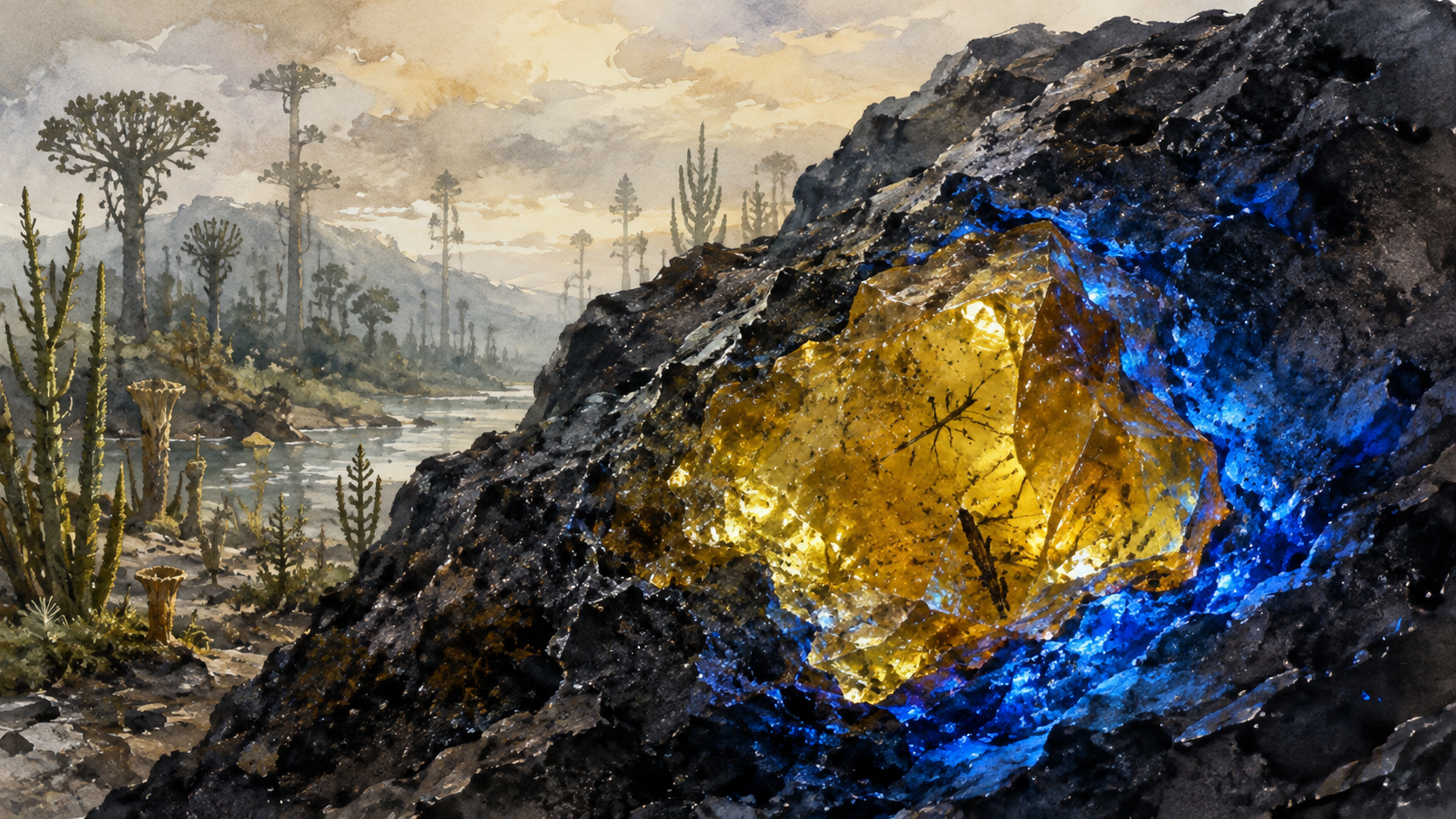
A 2026 Science Advances paper reports chemically confirmed amber from the Middle Devonian of Xinjiang, China, about 385 million years old. Most grains are only 0.1–0.5 mm across.
Researchers recovered 241 microscopic amber grains
UV screening of coal from the Hujiersite Formation revealed blue-fluorescent particles. The team recovered 241 grains and used FTIR and GC-MS rather than appearance alone to establish their fossil-resin chemistry.
The chemistry resembles later gymnosperm-type resins
Sesquiterpenoid and diterpenoid signatures were detected, with spectral features resembling later gymnosperm resins. This does not mean modern conifers existed in the Middle Devonian. It means complex terpenoid-resin chemistry arose much earlier than the familiar conifer lineages.
The producer plant remains unknown
Progymnosperms and arborescent lycopsids are among the plausible producers discussed, but the resin was not preserved in direct anatomical connection with a producer tissue. Assigning it to a specific plant would therefore go beyond the evidence.
The original function of resin is also unresolved
Modern resins participate in wound sealing, pathogen defense and herbivore interactions. The Devonian amber pushes the timeline of this chemistry backward, but the fossil alone cannot tell us which selective pressure originally favored resin production.
The major result is temporal: sophisticated vascular-plant resin chemistry existed by roughly 385 million years ago, well before the later diversification of seed plants.
For related context, see Was Cupuaçu Domesticated 8,000 Years Ago? What the Genome Actually Shows.
For related context, see The 4.83-Gb Ophrys sphegodes Genome Links Sexual Deception to Odor-Gene Duplications and an LTR Burst.
For related context, see LZUPSD: 4,496 Smartphone Images Covering 88 Seed Categories for Fine-Grained Recognition.
Reference
- Luo C et al. The earliest amber from the Middle Devonian of China. Science Advances. 2026;12:eaeh1266. https://doi.org/10.1126/sciadv.aeh1266
Comments