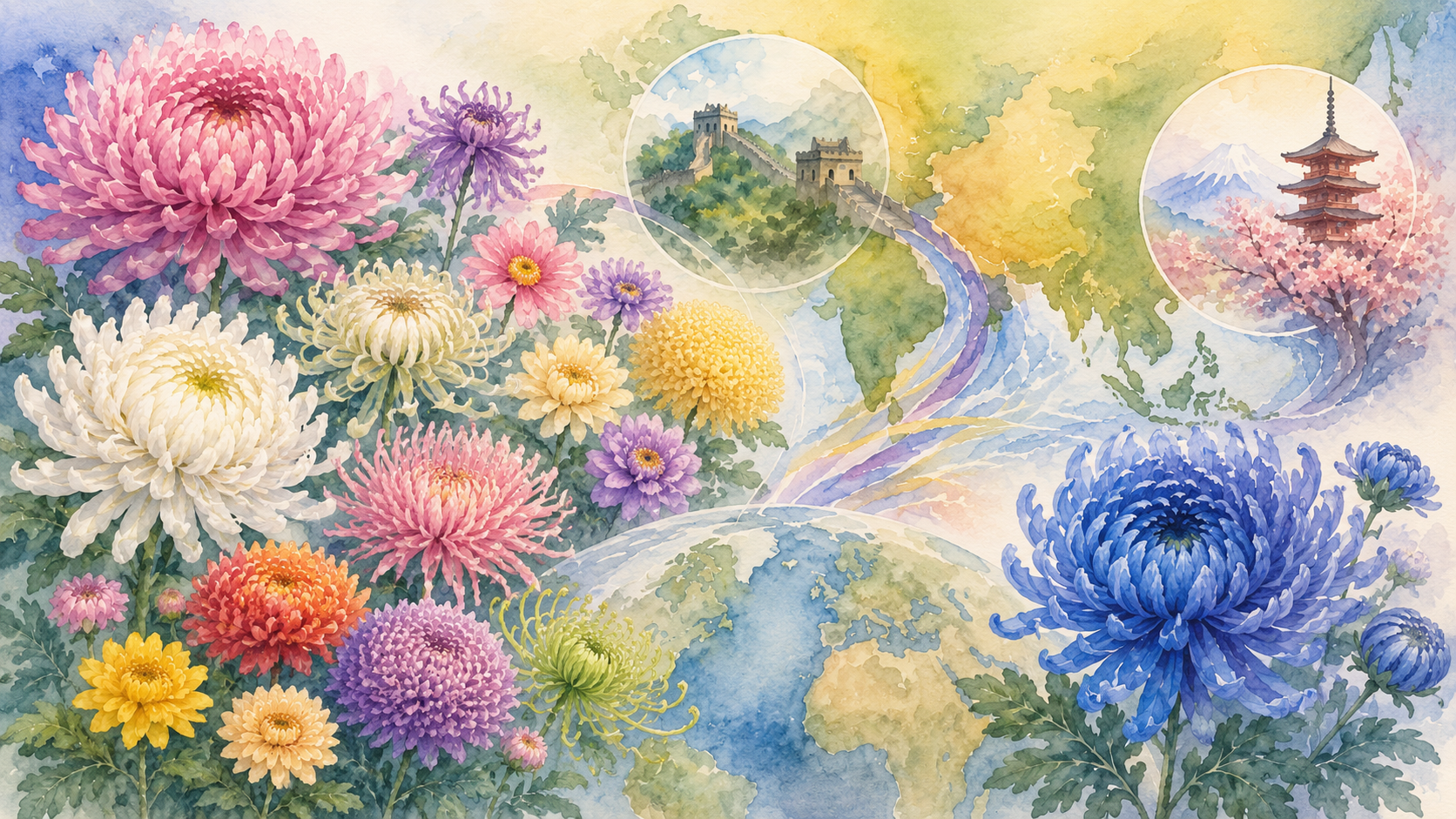
Chrysanthemums are deeply associated with traditional horticulture and ceremonial use in Japan, but they are also one of the world’s most important cut flowers.
So where did modern cultivated chrysanthemum, Chrysanthemum × morifolium, actually come from, and how did it become so diverse?
A large study published in Nature Plants on August 21, 2026 approached this question through a haplotype-resolved hexaploid genome and population genomics.
The study does not reduce chrysanthemum history to a single ancestral species. Instead, it shows that wild germplasm from both China and Japan repeatedly mixed through hybridization, introgression and selection, gradually creating the cultivated chrysanthemums we know today.
- The first challenge: chrysanthemum is hexaploid
- A complex family tree built from 147 accessions
- From China to Japan — and reshaped again in Japan
- The genome also points toward flower form and color
- Hexaploid does not simply mean genetic engineering is six times harder
- And yet, researchers made a blue chrysanthemum
- What the new hexaploid genome changes
- Summary
- References
The first challenge: chrysanthemum is hexaploid
Cultivated chrysanthemum is a hexaploid with 2n = 6x = 54 chromosomes.
A diploid plant carries two chromosome sets. Cultivated chrysanthemum carries six. In this study, the researchers reconstructed six haplotypes of the cut-flower cultivar ‘Jinba’.
That matters enormously for breeding and genetics.
In a hexaploid, a locus may be represented by multiple copies and alleles, and allele dosage can affect phenotype. Previous SNP-based studies have also provided genome-wide support for hexasomic inheritance in cultivated chrysanthemum.
This means chrysanthemum breeding cannot be understood with the simple diploid logic often used in textbook examples.
A complex family tree built from 147 accessions
The researchers constructed a genome-wide variation map from 147 core wild and cultivated accessions.
They resolved the material into four wild groups and four cultivated groups, with substantial gene flow among them.
One of the key conclusions is that modern cultivated chrysanthemum did not descend linearly from a single wild progenitor. Instead, wild germplasm from both China and Japan contributed substantially, and Chrysanthemum indicum was confirmed as one of the major ancestral taxa.
In other words, the history of cultivated chrysanthemum looks less like a simple branching tree and more like a network.
From China to Japan — and reshaped again in Japan
The historical model proposed in the paper is also fascinating.
According to the study, cultivated chrysanthemums were introduced from China into Japan around AD 729–748. After that, hybridization and introgression with Japanese wild chrysanthemums contributed to the formation of uniquely Japanese cultivated diversity.
Japan appears to have become a new center of diversity, especially for Disbud-type and Traditional-type chrysanthemums.
Later, Chinese cultivars reached Europe in the eighteenth century, and Japanese germplasm was reintroduced into European breeding programs in the late twentieth century, contributing to further diversification, including Spray-type cultivars.
What often looks like separate Chinese, Japanese and European chrysanthemum traditions turns out to be genetically interconnected.
The genome also points toward flower form and color
The study did more than reconstruct origin. It also searched for candidate loci associated with horticulturally important traits such as plant architecture, flower form and flower color.
That is especially important for breeding.
In a complex hexaploid crop, following traits through conventional crosses can be difficult. A six-haplotype reference genome, combined with diversity data from 147 accessions, makes it more realistic to ask: Which chromosome copy, which variant, and which dosage are associated with a given trait?
Hexaploid does not simply mean genetic engineering is six times harder
Hexaploidy does not mean transformation itself is literally six times harder.
If the goal is to add a new function through transgene introduction, expression from one or more insertion sites may be enough to generate the desired phenotype. Blue chrysanthemum is a good example.
The difficulty becomes greater when the goal is to disrupt, replace or completely eliminate the function of endogenous genes.
If multiple gene copies are present, phenotype may depend on how many copies are edited. Chrysanthemum is also highly heterozygous, strongly outcrossing, and genetically complex.
So the real challenge is not a simple factor of six. It is the need to handle multiple copies, allele dosage, high heterozygosity and complex inheritance at the same time.
And yet, researchers made a blue chrysanthemum
One of the most symbolic examples of molecular breeding in chrysanthemum is the blue chrysanthemum.
In 2017, researchers from NARO and the Suntory Global Innovation Center reported a genetically modified chrysanthemum with petals judged to be true blue.
Chrysanthemum naturally lacks the F3′5′H activity needed to produce delphinidin-based anthocyanins, which are often associated with blue flowers.
The researchers first introduced a Campanula-derived F3′5′H, enabling the flowers to accumulate delphinidin pigments. But that alone produced purple to violet flowers rather than a true blue.
They then added a butterfly-pea-derived anthocyanin 3′,5′-glucosyltransferase, further modifying the pigment structure.
The modified delphinidin pigments interacted with colorless flavone glycosides already present in chrysanthemum petals, and this copigmentation shifted the visible color into the blue range.
What the new hexaploid genome changes
At first glance, the 2026 Nature Plants paper and the 2017 blue-chrysanthemum study may seem like separate stories. In reality, they connect closely.
The blue chrysanthemum work showed that it is possible to create a flower color beyond conventional breeding by introducing new metabolic functions.
The new hexaploid genome now makes it easier to read the chrysanthemum genome itself: its six chromosome sets, its wild-derived mosaic history, and its complex allelic structure.
That should make future breeding strategies more precise, including:
- tracking dosage of alleles related to flower color and flower form
- selecting useful haplotypes
- designing genome editing with multiple copies in mind
- introducing useful alleles from wild germplasm more precisely
- combining transformation with genomic selection
Hexaploidy certainly makes chrysanthemum genetics more difficult. But that same complexity is also one of the reasons why chrysanthemum shows such extraordinary diversity in flower shape, size, branching pattern and flowering traits.
Summary
This Nature Plants study shows that cultivated chrysanthemum is not the product of a single simple origin. It is a highly complex hexaploid crop formed through repeated contributions from Chinese and Japanese wild germplasm.
That complexity makes breeding and genome analysis difficult. In particular, genome editing requires attention to multiple copies, allele dosage, heterozygosity and complex inheritance.
At the same time, that complexity is also a source of chrysanthemum’s extraordinary diversity.
And the blue chrysanthemum study shows that even in such a complex plant, understanding the underlying metabolic network can open traits that conventional breeding could not easily reach.
The better we learn to read complexity, the more precisely we can improve it.
References
Yuan C, Zhang R, Cong T, et al. The origin and domestication of modern cultivated Chrysanthemum × morifolium. Nature Plants. Published 21 August 2026. DOI: 10.1038/s41477-026-02366-w.
Noda N, Yoshioka S, Kishimoto S, et al. Generation of blue chrysanthemums by anthocyanin B-ring hydroxylation and glucosylation and its coloration mechanism. Science Advances. 2017;3:e1602785. DOI: 10.1126/sciadv.1602785.

Comments