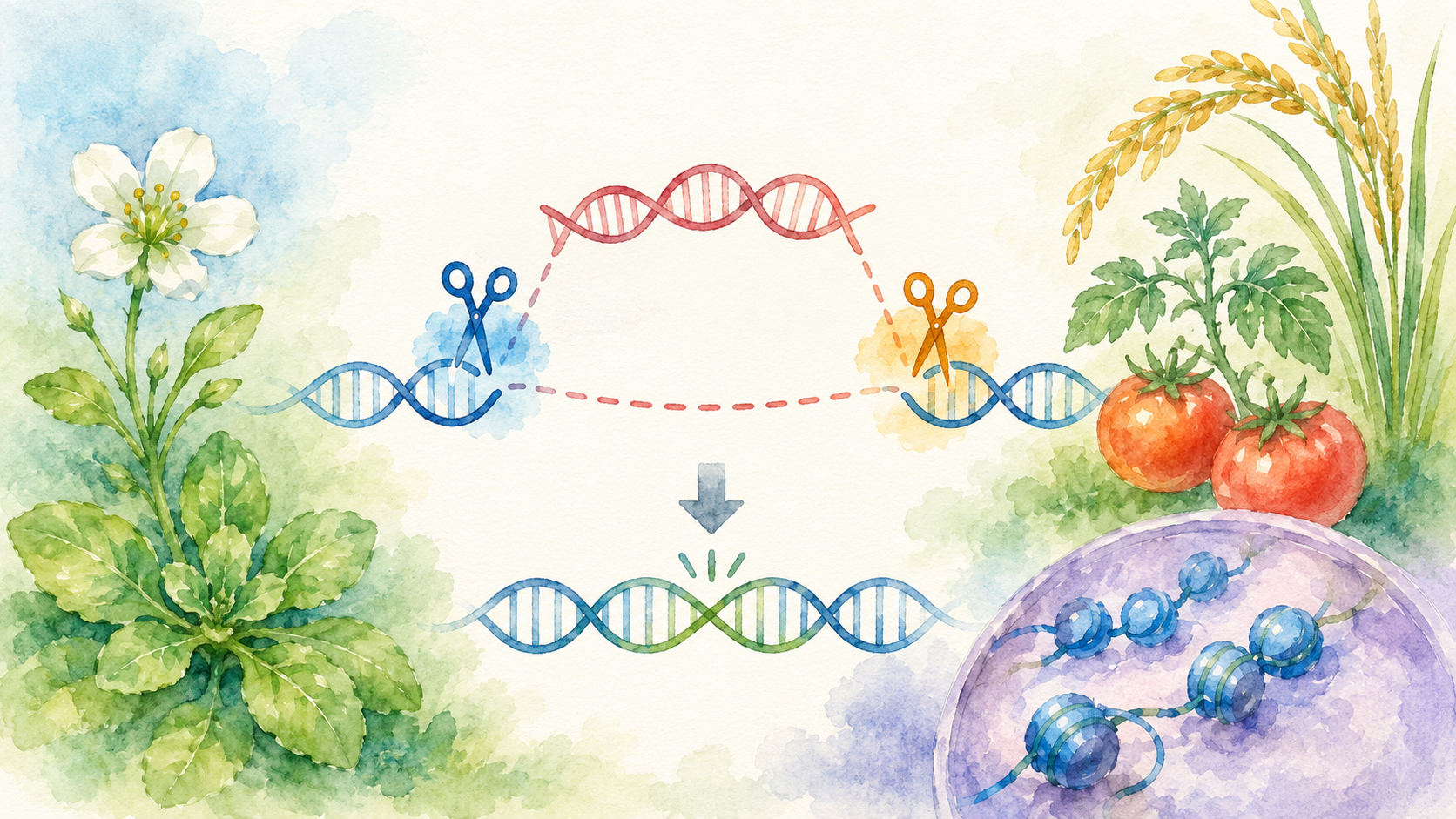
From “cutting one site in a gene” to “cutting out an entire interval of the genome.”
CRISPR/Cas9 is often introduced as a tool that uses one gRNA to cut one target and relies on repair to create a small indel that disrupts gene function. But if gRNAs are placed on both sides of a region, the DNA between the two cuts can also be removed as one contiguous segment.
Rather than focusing on a single paper, this article takes a cross-study look at plant genome editing in which two or more gRNAs flank a genomic region and delete the intervening DNA.
Once these studies are placed side by side, a curious picture appears. In rice, CRISPR researchers had already demonstrated a chromosomal deletion on the scale of 245 kb in 2014. Yet in another rice study, intended deletions were rarely recovered even when the two targets were separated by only 240 bp or roughly 1 kb.
A technology that can remove more than 100 kb can still fail across a few hundred base pairs.
That apparent contradiction is the central question here. Deletion distance matters, but the relationship is not simply “shorter means easier.” Both gRNAs must cut efficiently, the two cleavage events must overlap in the same cell within a useful time window, DNA repair must create the intended junction, and Cas9 must be able to access both targets in chromatin.
- Using two gRNAs to remove the DNA in between
- Put the studies side by side, and size does not map neatly onto efficiency
- A 245-kb deletion worked, while a 240-bp deletion could still be rare
- Between hundreds of bases and several kilobases, some deletions were inherited and linked to phenotype
- Tomato showed what happens when each side gets two chances to cut
- Why shorter deletions are not automatically more efficient
- gRNA activity is not determined by sequence alone
- From here, this is the author’s experimental impression and hypothesis
- A technology that can delete 100 kb can still fail to delete 1 kb
- Key references
Using two gRNAs to remove the DNA in between
With a conventional single-gRNA edit, Cas9 creates one DNA double-strand break (DSB). Repair often introduces a small insertion or deletion, which can disrupt a coding sequence through a frameshift or other local change.
A dual-gRNA deletion changes the logic. One gRNA is placed on each side of the region to be removed, creating two DSBs. If the intervening fragment is lost and the two outer DNA ends are rejoined, for example through non-homologous end joining (NHEJ), the entire interval between the cuts can disappear.
So although both approaches use CRISPR/Cas9, “creating a small mutation around one cut site” and “removing a genomic interval between two cut sites” place very different demands on the editing process.
Put the studies side by side, and size does not map neatly onto efficiency
Representative plant studies span an enormous range of deletion sizes.
| Plant / study | Main target | Deletion scale and result | Key point |
|---|---|---|---|
| Rice: Zhou et al. 2014 | Diterpenoid-related gene clusters | ~115, 170 and 245 kb | 170- and 245-kb deletions confirmed in regenerated T0 plants |
| Soybean: Cai et al. 2018 | GmFT2a / GmFT5a | 599–1,618 bp: 15.6%; >4.5 kb: 12.1% | Transgene-free homozygote and late flowering obtained in T2 |
| Arabidopsis: Durr et al. 2018 | Gene clusters and non-coding regulatory regions | Heritable targeted deletions | Extended paired-guide editing to clusters and regulatory DNA |
| Rice: Pathak et al. 2019 | GUS, OsPDS, OsChalk5 | 1,637, 987 and 240 bp | Individual cut sites mutated frequently, but intended deletions were rare |
| Rice: Akama et al. 2020 | OsGAD3 | 122 bp | Removing the CaM-binding domain raised GABA in brown rice about sevenfold |
| Tomato: Zhu et al. 2023 | SlyPDS | ~9 kb | Two guides on each side greatly improved deletion frequency |
| Sweet orange: Sopalda et al. 2026 | CsDMR6 | ~5.8 kb | Junction confirmed by Sanger sequencing in a transient system |
Read simply from smallest to largest, these studies do not produce a clean efficiency gradient. Instead, they show that the ease of obtaining a paired-guide deletion varies strongly from target to target even when the overall strategy is similar.
A 245-kb deletion worked, while a 240-bp deletion could still be rare
Rice had already reached the 245-kb scale in 2014
Zhou and colleagues demonstrated very large CRISPR/Cas9-induced chromosomal deletions in rice at an early stage of plant CRISPR research. In protoplasts, they detected deletion junctions across three targeted gene clusters of approximately 115, 170 and 245 kb.
The key point is that the work did not remain a transient-cell observation. Callus carrying the ~245-kb deletion was regenerated into T0 plants, and the deletion junction was confirmed by sequencing. A ~170-kb deletion was also recovered in regenerated T0 plants.
In other words, the feasibility of removing more than 100 kb of a plant genome as one interval was demonstrated surprisingly early.
But another rice study struggled even across 240 bp
Pathak and colleagues made the story much less straightforward.
They targeted defined deletions of 1,637 bp in GUS, 987 bp in OsPDS, and 240 bp in OsChalk5. Intended deletions could be detected in transformed callus, and deletion-positive callus could yield regenerated plants. But when regenerated plants were examined more broadly, the desired intervening deletions were uncommon.
At the same time, mutations at the individual gRNA target sites were frequent.
That distinction is important. Editing the left site, editing the right site, and having the two cuts cooperate to remove the DNA in between are not the same event.
Once a 245-kb deletion and a rarely recovered 240-bp deletion are viewed together, a simple distance-only model becomes difficult to defend.
Between hundreds of bases and several kilobases, some deletions were inherited and linked to phenotype
In soybean, Cai and colleagues used paired sgRNAs against the flowering-related genes GmFT2a and GmFT5a. For GmFT2a, deletions of 599–1,618 bp were found in 5 of 32 T0 plants, or 15.6%. Deletions larger than 4.5 kb were recovered in 4 of 33 plants, or 12.1%.
The study went beyond detecting a PCR band. In T2, the authors obtained a transgene-free homozygous mutant carrying a 1,618-bp deletion and confirmed a late-flowering phenotype. This is a relatively complete example in which a multi-kilobase deletion was generated, inherited, fixed, and connected to a biological trait.
In Arabidopsis, Durr and colleagues created heritable deletions involving not only individual genes but also gene clusters and non-coding regulatory regions. Paired-guide deletion can therefore be used not just to disrupt a coding gene, but to remove linked genes or cis-regulatory DNA as a genomic unit.
Akama and colleagues took the strategy in the opposite size direction. They targeted the C-terminal calmodulin-binding domain of rice OsGAD3 and recovered the expected 122-bp deletion. Brown rice from the deletion line accumulated about sevenfold more GABA than wild type. Paired-guide editing can therefore be used to “cut out” a specific functional protein domain rather than only a large genomic block.
In 2026, Sopalda and colleagues flanked approximately 5.8 kb of CsDMR6 in sweet orange with two gRNAs. After Agrobacterium-mediated transient delivery into leaf tissue, they detected the expected diagnostic PCR product and confirmed the deletion junction by Sanger sequencing.
That qualification matters. This was molecular confirmation in a transient system, not the establishment of stable sweet-orange plants carrying the 5.8-kb deletion.
Tomato showed what happens when each side gets two chances to cut
The 2023 study by Zhu and colleagues is especially useful for separating “distance” from “probability of successful cutting at both boundaries.”
For an approximately 9-kb region of tomato SlyPDS, a conventional dual-sgRNA design—one guide on each side—gave a deletion frequency of only 0.060% by targeted NGS and 0.69% by qPCR.
The researchers then used a double-pair strategy (DPS) with two sgRNAs on the left and two on the right, four guides in total. Under the same ~9-kb condition, the deletion estimate rose to 13.874% by targeted NGS and 41.99% by qPCR.
The absolute values differ substantially because the two assays measure the edited population differently. It would therefore be misleading to summarize the result simply as “the deletion rate was 42%.”
The robust conclusion is that the estimated absolute frequency depended on the assay, but providing multiple candidate cut sites on both sides produced a very large improvement over the conventional dual-sgRNA design.
This suggests that the problem was not merely “9 kb is too long.” A major bottleneck may instead be the probability of establishing effective cleavage at both boundaries in the same cell.
Why shorter deletions are not automatically more efficient
Distance is not irrelevant. As the two sites move farther apart, generating two appropriate DSBs in the same cell and rejoining the distal ends in the desired configuration may become more difficult.
But the plant data do not support a simple rule in which shorter always means more efficient.
A useful conceptual model is to think of the intended deletion as the product of several probabilities:
probability that the left site is cut × probability that the right site is cut × probability that both cuts occur in the same cell within a sufficiently close time window × probability that the outer DNA ends are rejoined
Suppose the left site is cut first and repaired by NHEJ. If that repair changes the gRNA recognition sequence or the PAM-proximal region, the site may become difficult or impossible for the same guide to cut again.
If the right site is cleaved only later, the cell may never contain the two simultaneous breaks needed for the intended deletion. The final genome can therefore carry local indels at one or both boundaries without ever producing the desired interval deletion.
Pathak et al.’s results fit this picture well. Zhu et al.’s improvement after adding redundant cut sites on both sides also suggests that the weaker guide or the timing of cleavage can become a bottleneck.
gRNA activity is not determined by sequence alone
This leads to another major variable: chromatin.
Cas9 does not encounter naked DNA in a test tube. Its substrate in vivo is DNA wrapped around nucleosomes and embedded in a genome shaped by DNA methylation, histone modifications, and other chromatin features.
Rice: the same spacer differed by as much as 13.4-fold between open and closed chromatin
Liu and colleagues analyzed editing by 70 sgRNAs targeting 41 rice genes and compared the results with chromatin accessibility defined using DNase I hypersensitive sites (DHS). Cas9 editing tended to be higher at more open, DHS-associated sites.
To reduce sequence-related confounding, they also compared five spacer sequences that each occurred in both an open- and a closed-chromatin context. With the spacer sequence held constant, in vivo editing was as much as 13.4-fold higher at the open site.
When the same target regions were provided as PCR products and cleaved by Cas9 RNP in vitro—removing chromatin from the equation—the large difference largely disappeared.
The implication is straightforward: even with the same gRNA sequence, editing can change depending on the chromatin environment in which that target resides.
Arabidopsis: identical target sequences differed by up to ~250-fold depending on locus
Weiss and colleagues made the comparison even more direct. They used identical CRISPR target sequences located at different genomic positions in Arabidopsis, allowing guide sequence to remain fixed while chromatin context changed.
Editing efficiency differed by as much as approximately 250-fold among loci. Poorly edited sites were associated with repressive features including DNA hypermethylation, low DNA accessibility, H3K9 methylation, and H2A.W, whereas higher accessibility and some histone-acetylation features were associated with better editing.
When DNA methylation was strongly reduced, editing at some low-efficiency loci improved by 2.1- to 4.8-fold.
But this does not mean “open chromatin always gets cut.” Some accessible targets still edited poorly. Chromatin accessibility is an important factor, not a complete explanation; guide sequence, local DNA properties, Cas9 expression, cell state, and repair pathways also matter.
From here, this is the author’s experimental impression and hypothesis
Everything above is based on published studies. The following is deliberately separated as the author’s own experimental impression and hypothesis from working with plant genome editing.
In practical plant genome-editing experiments, gRNAs designed under very similar criteria can behave strikingly differently. Some cut almost unusually well, while others barely work. Sequence-based prediction scores do not always explain the difference cleanly.
The strongest published evidence currently concerns local chromatin accessibility, nucleosome occupancy, DNA methylation, histone modifications, and related epigenetic features.
Beyond that, my own impression is that not only local open-versus-closed chromatin but also how DNA is positioned and folded within the nucleus—its higher-order chromatin configuration—may influence how easily Cas9 reaches a target.
That remains a hypothesis. It would be too strong to state that plant 3D genome structure has already been demonstrated to determine the activity of individual gRNAs. At present, the strongest evidence concerns local accessibility, nucleosomes, DNA methylation, and histone modifications.
A technology that can delete 100 kb can still fail to delete 1 kb
After looking across these studies, we return to the contradiction that motivated the article.
The same general technology can remove more than 100 kb, yet at another locus it may rarely generate the intended deletion across ~1 kb—or even 240 bp.
This becomes easier to understand once CRISPR/Cas9 is viewed as more than a sequence-recognition system.
What Cas9 actually encounters is a chromatinized genome inside the nucleus. And for a dual-gRNA deletion, favorable conditions must be achieved not at one site but at two sites in the same cell within an appropriate time window, followed by DNA repair that creates the desired junction.
So “245 kb worked, therefore 1 kb should be easy” is not a reliable assumption.
Deletion design has to consider more than distance: the activity of both boundary guides, synchrony of cleavage, local chromatin, the possibility of recutting after repair, and, when useful, redundancy from multiple guides on each side.
A technology that can delete 100 kb can still fail to delete 1 kb.
That apparent contradiction is a useful reminder that plant CRISPR is not simply a technology for cutting a DNA sequence. It is a technology for editing a genome as it actually exists inside the cell nucleus.
Key references
- Zhou H. et al. (2014). Large chromosomal deletions and heritable small genetic changes induced by CRISPR/Cas9 in rice. Nucleic Acids Research. DOI: 10.1093/nar/gku806
- Durr J. et al. (2018). Highly efficient heritable targeted deletions of gene clusters and non-coding regulatory regions in Arabidopsis using CRISPR/Cas9. Scientific Reports. DOI: 10.1038/s41598-018-22667-1
- Cai Y. et al. (2018). CRISPR/Cas9-Mediated Deletion of Large Genomic Fragments in Soybean. International Journal of Molecular Sciences. DOI: 10.3390/ijms19123835
- Pathak B. et al. (2019). Dual-targeting by CRISPR/Cas9 leads to efficient point mutagenesis but only rare targeted deletions in the rice genome. 3 Biotech. DOI: 10.1007/s13205-019-1690-z
- Liu G. et al. (2019). Modulating chromatin accessibility by transactivation and targeting proximal dsgRNAs enhances Cas9 editing efficiency in vivo. Genome Biology. DOI: 10.1186/s13059-019-1762-8
- Akama K. et al. (2020). An In Vivo Targeted Deletion of the Calmodulin-Binding Domain from Rice Glutamate Decarboxylase 3 (OsGAD3) Increases γ-Aminobutyric Acid Content in Grains. Rice. DOI: 10.1186/s12284-020-00380-w
- Weiss T. et al. (2022). Epigenetic features drastically impact CRISPR–Cas9 efficacy in plants. Plant Physiology. DOI: 10.1093/plphys/kiac285
- Zhu G. et al. (2023). Efficient large fragment deletion in plants: double pairs of sgRNAs are better than dual sgRNAs. Horticulture Research. DOI: 10.1093/hr/uhad168
- Sopalda S. et al. (2026). Dual-gRNA CRISPR/Cas9 Deletion of CsDMR6 in Sweet Orange Supported by Improved In Vitro Regeneration. Plants. DOI: 10.3390/plants15172664


Comments