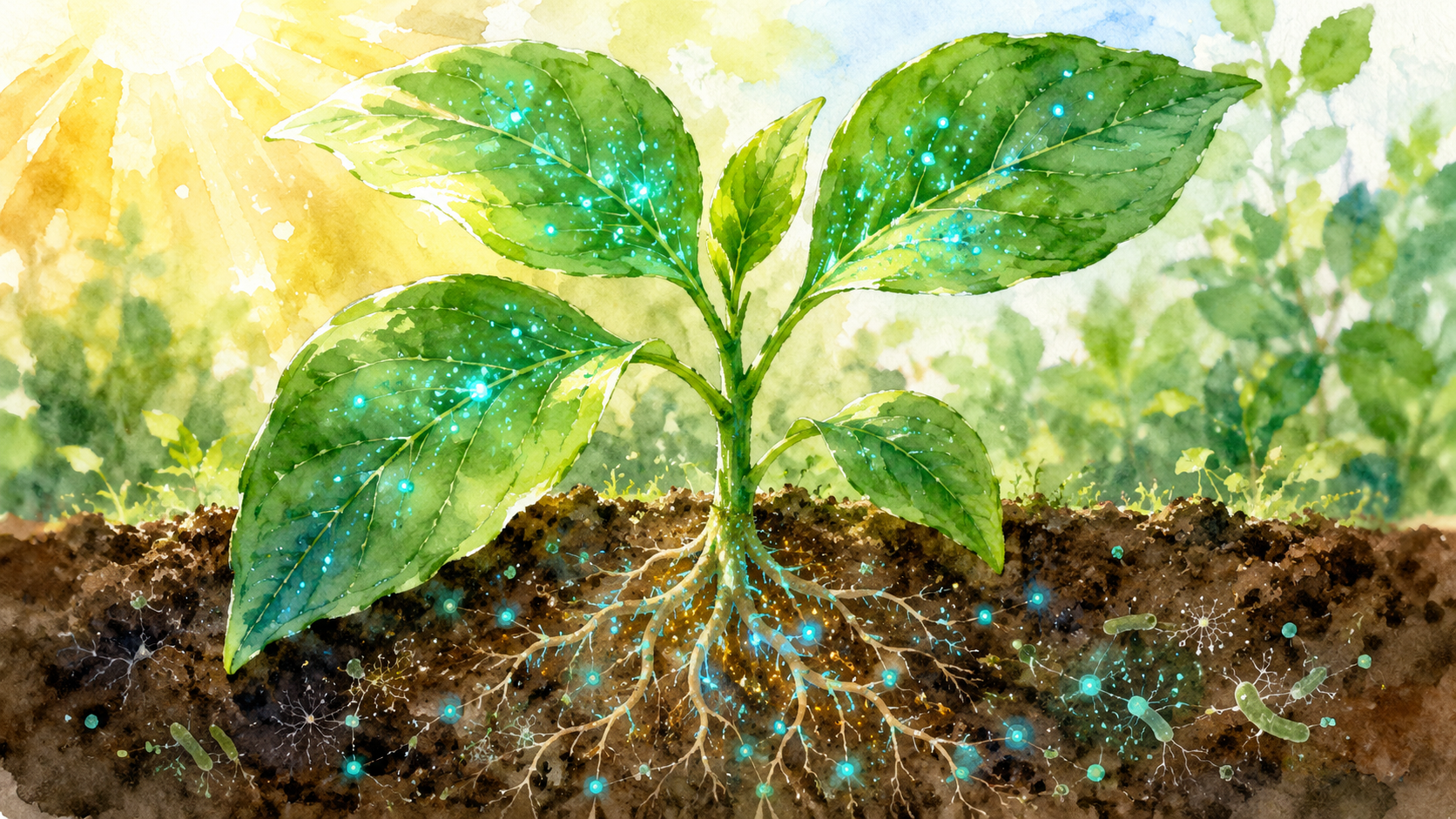
On August 30, 2026, two papers on the use of carbon dots in plants were published on the same day.
One examined foliar application of carbon dots to cotton, comparing concentration-dependent effects on growth, photosynthesis, antioxidant responses, and metabolism. The other tested carbon quantum dots (CQDs) together with ectoine in the medicinal plant Gentiana rhodantha under heat stress.
The plant species and experimental aims were different, but both studies treated carbon dots as materials capable of modulating plant physiological state.
The fact that the two papers appeared on the same day is almost certainly a coincidence. But when the 2026 literature is viewed more broadly, it becomes clear that plant and agricultural carbon dot research has been unusually active. Reviews have appeared in succession, while experimental studies have expanded into field rice, seed priming, heat-induced sterility, heavy-metal mitigation, and rhizosphere microbiology.
Carbon dots did not suddenly emerge in 2026. A better interpretation is that the field has begun to move beyond the earlier phase of repeatedly showing that “carbon dots can sometimes promote plant growth or stress tolerance” toward field validation, multi-omics, rhizosphere biology, and combination formulations.
- What are carbon dots?
- Cotton studies are beginning to connect dose with metabolism
- The second August 30 paper did not use carbon dots alone
- Why can carbon dots affect plants?
- One of the most interesting 2026 developments: connecting leaves to the rhizosphere
- From seedlings to field trials: a major change in 2026
- Cadmium-contaminated rice fields: linking leaves, roots, microbes, and iron cycling
- Low doses may stimulate while high doses inhibit
- The biggest problem remains reproducibility: can we reproduce what was actually applied?
- What is needed before we can confidently call these mechanisms?
- 2026 is less the year of commercialization than the year the questions changed
- Key references
What are carbon dots?
Carbon dots (CDs) are generally carbon-based nanomaterials smaller than about 10 nm. Many consist of a small carbon-rich core surrounded by a surface layer containing functional groups such as carboxyl, hydroxyl, and amino groups. They are also well known for absorbing ultraviolet or visible light and emitting fluorescence.
Closely related terms include carbon quantum dots, carbon nanodots, carbonized polymer dots, and graphene quantum dots. These names do not always describe identical materials, and the boundaries between categories can be inconsistent across the literature.
The most important point is that a carbon dot is not a single, structurally fixed compound in the way sodium chloride is.
Carbon dots made from citric acid and urea, sugars or amino acids, microalgae, or plant biomass can differ substantially even when all are labeled “carbon dots.” The precursor is only one variable. Reaction temperature, time, pH, solvent, heteroatom doping such as nitrogen doping, and downstream purification by dialysis or chromatography can all change particle size, surface charge, functional groups, optical behavior, electron-donating ability, and interactions with reactive oxygen species (ROS).
If low-molecular-weight fluorophores or unreacted precursors are not removed sufficiently after synthesis, some of the observed fluorescence or biological activity may come from these coexisting molecules rather than the nanoparticle itself.
It is therefore more accurate to think of carbon dots not as “one agricultural substance,” but as a design class of nanomaterials whose structure and surface properties can be tuned.
This matters when comparing plant studies. If one study finds 100 mg/L to be optimal, that does not mean 100 mg/L of a differently synthesized carbon dot will behave the same way. Even at the same nominal carbon concentration, particle number, surface area, charge, fluorescence quantum yield, and functional-group density may differ.
Cotton studies are beginning to connect dose with metabolism
The Plants paper published on August 30 applied carbon dots to cotton leaves at concentrations from 0 to 200 mg/L and measured growth, photosynthetic pigments, gas exchange, antioxidant responses, and metabolites.
The strongest growth-promoting effects were observed around 100 mg/L. Under that condition, shoot and root fresh and dry weights increased, while chlorophyll a, carotenoids, and net photosynthetic rate also improved. Untargeted metabolomics further detected broad metabolic shifts, including changes in pathways related to phenylpropanoid and flavonoid biosynthesis.
The study therefore tried to go beyond the simple observation that treated plants became larger. It linked growth with photosynthesis, redox-related responses, and secondary metabolism.
However, altered metabolic pathways do not by themselves establish a direct causal chain from carbon-dot exposure to growth promotion. It remains necessary to distinguish early primary responses from downstream metabolic changes that occur because the plant is already growing differently.
The same research group also published a cotton study in February 2026 using citric-acid-derived carbon dots. Again, concentrations around 100 mg/L performed well. In addition to improved biomass, photosynthesis-related traits, and SOD and POD activity, RNA-seq showed changes in genes associated with light-harvesting complexes and flavonoid biosynthesis.
These two papers should not be counted as independent replication by separate groups. They are better viewed as a continuing research program in which the same biological system is being examined at progressively deeper levels, moving from transcriptomics toward metabolomics.
The second August 30 paper did not use carbon dots alone
The Agronomy paper published the same day exposed Gentiana rhodantha to heat stress and treated the plants with CQDs, ectoine, or both.
Ectoine is a compatible solute involved in osmotic adjustment and protection of proteins and membranes. The study compared biomass, root-system traits, SPAD values, nitrogen status, antioxidant enzymes, and osmotic-regulation compounds under the different treatments.
The combined treatment did not outperform the single treatments for every measured variable, but the authors reported broad mitigation of heat-induced growth inhibition and physiological disruption.
What makes this study notable is that carbon dots were not treated as a stand-alone growth promoter. Instead, they were combined with a molecule expected to act through a different protective mechanism.
If carbon dots influence photosynthesis, electron transfer, and cellular redox state while ectoine stabilizes proteins and membranes, the combination could address different physiological vulnerabilities at the same time. This points toward a shift from screening single materials to formulation design for combined biostimulants.
Why can carbon dots affect plants?
No single mechanism can explain the full range of plant responses reported for carbon dots. At present, several partially overlapping routes are being considered: optical effects, electron transfer, redox regulation, metabolic and nutritional effects, and indirect effects extending into the rhizosphere.
Converting light to different wavelengths
Many carbon dots absorb ultraviolet or short-wavelength visible light and re-emit light at longer wavelengths. They are therefore sometimes described as fluorescent converters that could transform poorly used wavelengths into light that plants can use more effectively for photosynthesis.
That explanation is plausible in principle but should not be overextended. Carbon-dot fluorescence can arise from several sources, including the carbon core, surface states, carbonized polymer structures, and low-molecular-weight fluorophores generated during synthesis. Demonstrating that a material fluoresces is not the same as demonstrating that its fluorescence makes a quantitatively important contribution to photosynthesis inside a leaf.
Claims of upconversion fluorescence—emission of shorter-wavelength light after longer-wavelength excitation—also require particular caution because spectrometer artifacts such as second-order diffraction have long been known to produce misleading signals. Mechanistic claims based on upconversion therefore need strong optical controls.
Possible participation in photosynthetic electron transport
A second possibility is that photoexcited carbon dots can act as electron donors rather than merely as wavelength converters.
In a study using nitrogen-doped carbon dots in apple, particles were observed near chloroplasts and thylakoid structures, and an in-vitro system showed electron transfer from photoexcited carbon dots to plastoquinone PQ-9.
This supports a model in which certain carbon dots may interact more directly with photosynthetic electron transport. But the result applies to a particular nitrogen-doped material and cannot automatically be generalized to every material called a carbon dot.
Changing plant redox responses, not simply scavenging ROS
Functional groups on carbon-dot surfaces can react with ROS. At the same time, carbon-dot treatments often alter plant antioxidant systems including SOD, POD, CAT, and the ascorbate–glutathione network.
These are not the same mechanism. Direct chemical ROS scavenging by the material must be distinguished from induction of the plant’s own defense system. A third possibility is that improved photosynthetic function changes ROS production secondarily.
An increase in antioxidant-enzyme activity alone is therefore not sufficient evidence that carbon dots directly scavenge radicals in vivo.
One of the most interesting 2026 developments: connecting leaves to the rhizosphere
A particularly interesting trend in 2026 is the appearance of studies that follow the consequences of shoot-applied carbon dots all the way to the rhizosphere.
The connection could involve transport of the particles themselves, but it could also be indirect. If foliar treatment changes photosynthesis and carbon or nitrogen metabolism, the composition of sugars, organic acids, amino acids, and other compounds released by roots may change, which can in turn alter the rhizosphere environment and microbial community.
If plant internal responses and soil-microbial responses are tightly linked, carbon dots may need to be viewed not only as foliar agents but as materials capable of influencing the entire plant–soil system.
The causal chain, however, is long. A correlation between foliar treatment and microbial-community change does not prove the intervening steps. Particle tracing, root-exudate analysis, and microbial inoculation experiments will be needed to establish mechanism.
From seedlings to field trials: a major change in 2026
Many earlier carbon-dot studies relied on Petri dishes, hydroponics, pots, or young seedlings. In 2026, more studies have evaluated field-level outcomes such as yield, grain quality, heat-induced sterility, and heavy-metal transfer.
Rice seed priming with Spirulina-derived carbon dots has been reported to improve germination, root growth, and early seedling development. Proteomic analysis also identified changes in proteins related to translation, energy metabolism, and ion and nutrient homeostasis.
However, when a related carbon-dot material was applied foliarly to rice in field experiments, changes in metabolic indicators under favorable conditions did not consistently translate into higher yield. Under reproductive-stage heat stress, by contrast, the treatment reduced sterility and supported yield stability.
That contrast is important.
One of the most meaningful advances in 2026 is not simply that more studies report carbon dots “working,” but that we are beginning to see when they do not work.
Under optimal conditions, an additional growth-promoting effect may be small. Under heat, salinity, drought, excess light, or heavy-metal stress, carbon dots may instead act by helping the plant maintain physiological homeostasis.
If that interpretation holds, carbon dots may be better positioned as stress-dependent physiological conditioners than as universal growth promoters applied continuously.
Cadmium-contaminated rice fields: linking leaves, roots, microbes, and iron cycling
Another 2026 field study applied carbon dots foliarly to rice grown in cadmium-contaminated paddy soil and examined not only yield and grain Cd concentration but also leaf redox responses, rhizosphere microbes, and iron cycling.
At 100 mg/L, the study reported increased yield and reduced Cd concentration in brown rice. Rhizosphere changes included shifts in iron-oxidizing bacterial groups and iron cycling, together with greater Cd immobilization in iron plaque on root surfaces.
The mechanistic model proposed by this work is ambitious: foliar carbon dots alter leaf redox state and metabolism; those changes propagate belowground; the rhizosphere microbiome and iron cycling shift; more Cd becomes immobilized at the root surface; and less Cd reaches the grain.
That is an intriguing system-level hypothesis. But “these changes occurred together” must still be distinguished from “they occurred in this specific causal order.” Direct tracing of carbon dots and stronger causal tests linking leaf metabolism to rhizosphere iron cycling will be needed.
Low doses may stimulate while high doses inhibit
Dose dependence is another recurring issue.
In soybean concentration experiments, relatively low to moderate concentrations have promoted photosynthesis and growth, whereas much higher concentrations such as 500–1,000 mg/L have produced leaf accumulation or injury and reduced PSII activity and growth.
A material that is beneficial around 100 mg/L will not necessarily become more effective at higher concentrations. Potential high-dose effects include optical shading, surface deposition, excessive electron transfer, ROS generation, membrane interactions, and particle aggregation.
This low-dose stimulation and high-dose inhibition can resemble a hormetic response. But it is important not to generalize 100 mg/L as an “optimal carbon-dot concentration for plants.” Effective and toxic ranges will vary with particle size, surface chemistry, and formulation.
The biggest problem remains reproducibility: can we reproduce what was actually applied?
Even in 2026, reproducibility remains one of the central weaknesses of carbon-dot research.
Using the same precursor does not guarantee the same product. Heating apparatus, temperature ramp, reactor geometry, concentration, pH, and purification can all alter the final material. Two laboratories following nominally similar methods may obtain particles that differ in size distribution, surface functional groups, zeta potential, and fluorescence quantum yield.
Recent reviews focused on standardization have highlighted batch-to-batch variability, ambiguous classification, and inconsistent reporting of synthesis and post-treatment as obstacles to reproducibility, scale-up, and regulatory evaluation.
Plant experiments add another layer of complexity. In foliar applications, uptake can depend on wettability, aggregation, surfactants, leaf age, cuticle properties, stomatal density, time of application, light, and humidity. Seed treatment, root treatment, and foliar treatment may expose completely different biological interfaces.
A statement such as “100 mg/L carbon dots were sprayed” is therefore not, by itself, a complete description of the treatment.
What is needed before we can confidently call these mechanisms?
Several issues will become increasingly important as the field matures.
1. Define the material
Studies should report precursors, synthesis conditions, purification, yield, particle size, TEM, surface charge, XPS, FTIR, Raman spectra, absorption and emission spectra, and quantum yield, and should test whether those properties are reproduced across batches.
2. Use stronger controls
Unreacted precursors, solutions with matched carbon or nitrogen content, dialysate, nanoparticle-depleted low-molecular-weight fractions, and pH-matched controls can help separate the effects of the nanomaterial from those of coexisting compounds.
3. Track the material directly in the plant
Seeing fluorescence is not necessarily proof that intact particles reached a tissue. Fluorescent molecules may dissociate or move independently. Stable isotopes, elemental analysis, separation methods, electron microscopy, and complementary tracing approaches are needed.
4. Test dose, timing, genotype, and environment together
The field needs more than simple treated-versus-untreated comparisons. Dose, species, genotype, developmental stage, light, temperature, water status, and soil conditions should be tested in combinations that reveal both responsive and nonresponsive conditions.
5. Evaluate yield, quality, safety, persistence, and economics in the field
Improved biomass or SPAD values alone are not enough to establish an agricultural input. Multi-location and multi-year yield trials, edible-tissue exposure, soil persistence, long-term microbiome effects, manufacturing consistency, and cost will all matter.
2026 is less the year of commercialization than the year the questions changed
The 2026 literature makes carbon dots look highly promising. They may influence photosynthesis, electron transfer, redox regulation, metabolism, nutrient acquisition, rhizosphere microbiology, heat-induced sterility, and heavy-metal transfer across multiple levels of plant production.
But reducing all of this to “carbon dots make plants healthier” would miss what is scientifically most interesting.
Carbon dots are not simply a carbon fertilizer, nor are all carbon-dot products interchangeable biostimulants. Their optical behavior, electron-transfer properties, and surface reactivity depend on how they are made, while plant responses depend on species, genotype, dose, timing, and environmental stress.
By 2026, carbon-dot research in plants is shifting from the question “Do carbon dots work?” toward “Which carbon dots, on which plants, at what time and dose, under which conditions, produce which effects?”
Under favorable conditions, yield may not change. Under heat stress, yield stability may improve. A foliar treatment may be associated with changes in rhizosphere iron cycling and microbial communities. Carbon dots are now being tested not only alone but also in combination with compounds such as ectoine.
That is why carbon dots are beginning to look less like simple photosynthesis enhancers and more like a platform for environment- and crop-specific nano-biostimulant design.
The field is promising, but it is still too early to generalize from the term “carbon dots” alone.
2026 is not the year carbon-dot agriculture was completed. It may instead be the year when the questions required to make it real finally became concrete.
Key references
- Plants 2026, 15(17), 2659 — Foliar carbon-dot application and metabolomic analysis in cotton
- Agronomy 2026, 16(17), 1660 — CQDs plus ectoine for mitigation of heat stress
- This overview also draws on 2026 reviews and experimental studies of carbon dots in plant and agricultural systems, including rice field trials, seed priming, cadmium mitigation, and rhizosphere analyses.


Comments