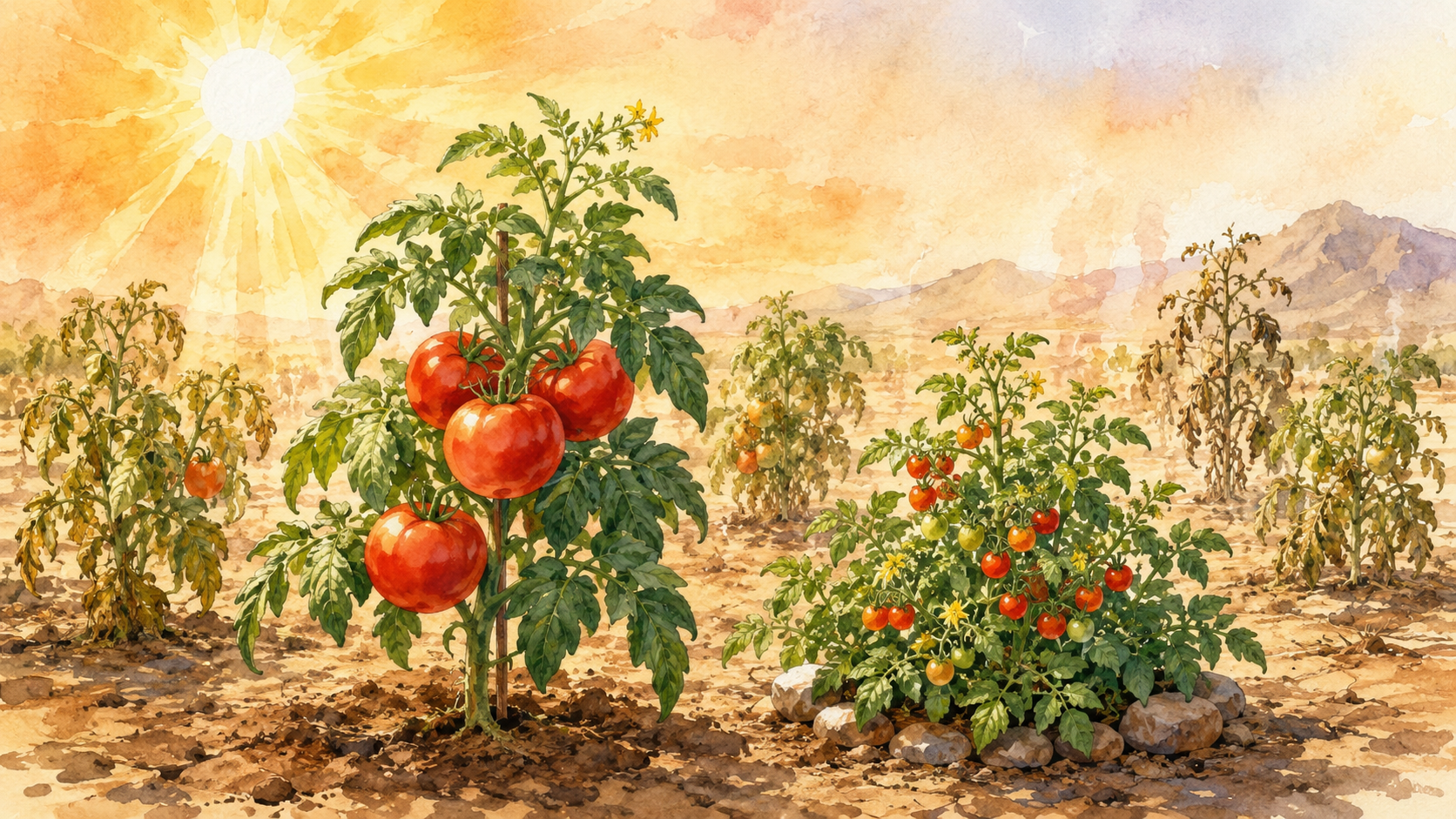
Plant breeding is often imagined as the process of combining useful genes that we already know about. But plant research sometimes suggests the opposite problem: perhaps we still have not found many of the useful capabilities that plants already possess.
A study published in BMC Plant Biology in August 2026 compared two cultivated tomato cultivars and 11 accessions of wild relatives, for a total of 13 genotypes, under acute heat stress reaching 45°C. The researchers did not look only at growth. They measured water status, chlorophyll, membrane damage, proline, and the antioxidant enzymes SOD and CAT to examine how different plants cope with severe heat.
Original paper: Şimsek E, Yıldız K, Çevik S, et al. Integrative systems analysis reveals heat-induced functional divergence in cultivated and wild tomato genotypes. BMC Plant Biology. Published 28 August 2026. https://link.springer.com/article/10.1186/s12870-026-09807-w
At first glance, this can look like a simple comparison between cultivated and wild tomatoes. A closer reading reveals something more interesting: plants that rank similarly for heat tolerance do not necessarily tolerate heat in the same way.
There is more than one way to be heat tolerant
The cultivated cultivar İksir and the wild Solanum pimpinellifolium accession PI 365957 ranked near the top of the integrated evaluation. Yet their responses were quite different.
İksir stood out for maintaining growth under heat. PI 365957, by contrast, showed strong cellular protection: MDA, a marker of lipid peroxidation and membrane damage, decreased markedly, while CAT activity increased strongly. In other words, one genotype appears particularly good at continuing to grow, while the other shows a strong capacity to protect cells from oxidative damage.
Other accessions revealed still more combinations.
| Genotype | Notable response in this study | A possible “component” of heat tolerance |
|---|---|---|
| İksir | Maintained biomass under heat | Capacity to keep growing |
| PI 365957 | CAT +200.7%, MDA −59.9% | ROS control and membrane protection |
| PI 231257 | SOD +75.4%, the largest increase | Strong SOD response |
| PI 246502 | Very high CAT/SOD and membrane-stability scores | Strong antioxidant defense |
| PI 365918 | CAT +159.6%, MDA −56.3%, chlorophyll +20.8% | Strong individual cellular defenses despite low overall tolerance |
| Kamenta | Proline +127.8%, SOD +44.1% | Osmotic adjustment plus antioxidant response |
PI 231257 showed the largest SOD increase in the experiment, at 75.4%. PI 365918 was not among the strongest genotypes overall, yet its CAT increased by 159.6%, MDA fell by 56.3%, and total chlorophyll increased by 20.8%.
Particularly striking is S. pennellii PI 246502. In the membership-function analysis, its biomass and height scores were both 0, whereas CAT and SOD were both 1.00 and membrane stability was 0.99. It was not a plant that simply “grew well in the heat,” but some of its cellular defense traits were among the strongest in the panel. The authors likewise note its strong antioxidant response together with a substantial vegetative penalty.
That is one of the most interesting messages of the paper.
Looking only for the strongest plant may miss useful material
If heat tolerance is evaluated only by asking which plants remain largest after heat treatment, genotypes such as İksir and PI 365957 are easy to notice.
But that approach could discard a genotype such as PI 246502 as merely heat sensitive.
Once heat tolerance is decomposed, however, several different components emerge: maintenance of growth, preservation of the photosynthetic apparatus, membrane protection, water retention, ROS scavenging, and osmotic adjustment.
The membership-function analysis also shows that genotypes can rank modestly overall while being exceptional for particular traits. This is why wild relatives are valuable not only as sources of a complete “heat-tolerant phenotype,” but also as reservoirs of individual traits that may be useful in breeding.
The breeding question therefore does not have to be, “Which wild tomato is the most heat tolerant?” It could instead become: which accession carries strong membrane protection, which carries an unusual SOD response, which maintains water status, and which preserves growth?
Future QTL mapping, GWAS, RNA-seq, comparative genomics and functional studies could identify the alleles and regulatory mechanisms responsible for those differences. This study does not identify the causal genes. In that sense, much of the interesting work still remains to be done.
Even accessions of the same species can behave very differently
PI 365957 and PI 365918 are both S. pimpinellifolium, yet their integrated heat-tolerance profiles are quite different. PI 365957 ranked near the top, while PI 365918 ranked much lower. Even so, PI 365918 showed strong CAT induction, membrane protection and chlorophyll maintenance.
The authors emphasize this accession-level variation. Saying simply that “S. pimpinellifolium is a source of heat tolerance” is therefore too coarse. Important diversity exists within the species itself.
This has an encouraging implication for germplasm exploration. Large collections held around the world may contain useful traits that are invisible when accessions are judged only by a single final phenotype. A plant that looks mediocre overall may still contain one unusually valuable physiological capability.
Now for a bit of speculation
Looking at these contrasting physiological responses raises another question.
If their stress physiology differs this much, could their fruits also differ in flavor or quality?
The present study does not test this. It examined acute heat stress during vegetative growth and did not measure fruit sugar, acidity, organic acids, volatile compounds or sensory quality. It therefore provides no evidence that any of these accessions is more or less flavorful.
Still, there are reasons why the question is interesting.
Large-scale tomato studies have shown that domestication and subsequent breeding altered alleles associated with sugars, organic acids, amino acids and flavor-related volatile compounds, while wild germplasm retains combinations that are absent from many modern cultivars. See: https://www.nature.com/articles/s41467-019-09462-w
Studies using introgression lines carrying wild tomato genomic regions have also shown that a single wild-derived region can influence metabolites, gene expression and fruit-ripening networks together. Plant traits are not always separable into a simple “one gene, one property” relationship. See: https://www.nature.com/articles/s41588-020-0690-6
More recently, natural variation in wild and cultivated tomatoes helped identify regulators of sugar accumulation, and genome editing was used to raise fruit sugar content by up to roughly 30% without reducing fruit weight or yield. This is a good example of germplasm exploration revealing an improvement target that was not obvious from modern cultivars alone. See: https://www.nature.com/articles/s41586-024-08186-2
So it is tempting to wonder whether the membrane-protection phenotype of PI 365957, the strong ROS response of PI 231257, or some unusual feature of PI 365918 might also be connected—directly or indirectly—to fruit metabolism under heat.
We do not know. It would have to be measured.
But that is part of the enjoyment of reading research papers: the data do not only answer questions. They generate the next ones. A paper about heat tolerance can unexpectedly leave you wondering what the tomatoes taste like.
Plants may still contain much of the material we need for future improvement
This study does not identify the causal genes behind these heat-response differences. Nor can it prove that domestication itself caused the cultivated–wild differences observed here. The panel contains only 13 genotypes, and broader germplasm surveys will be needed.
Even so, one point is clear: the phenotype we call “heat tolerance” can be produced by different combinations of physiological responses.
And even genotypes that are not outstanding overall may contain exceptional individual traits.
Humans have already changed crop plants enormously, but we have not catalogued every useful solution that plant evolution has generated. If heat tolerance alone contains this much diversity, the remaining variation in drought tolerance, salinity, disease resistance, nutrient efficiency, fruit quality and flavor is likely to be extensive as well.
As technologies for designing and editing plants improve, there is still another equally important direction: finding what plants already have.
That is the main idea this paper left me with.
Note: the currently available manuscript is an accepted Article in Press version. Springer Nature states that errors may still be corrected before the final Version of Record.

Comments