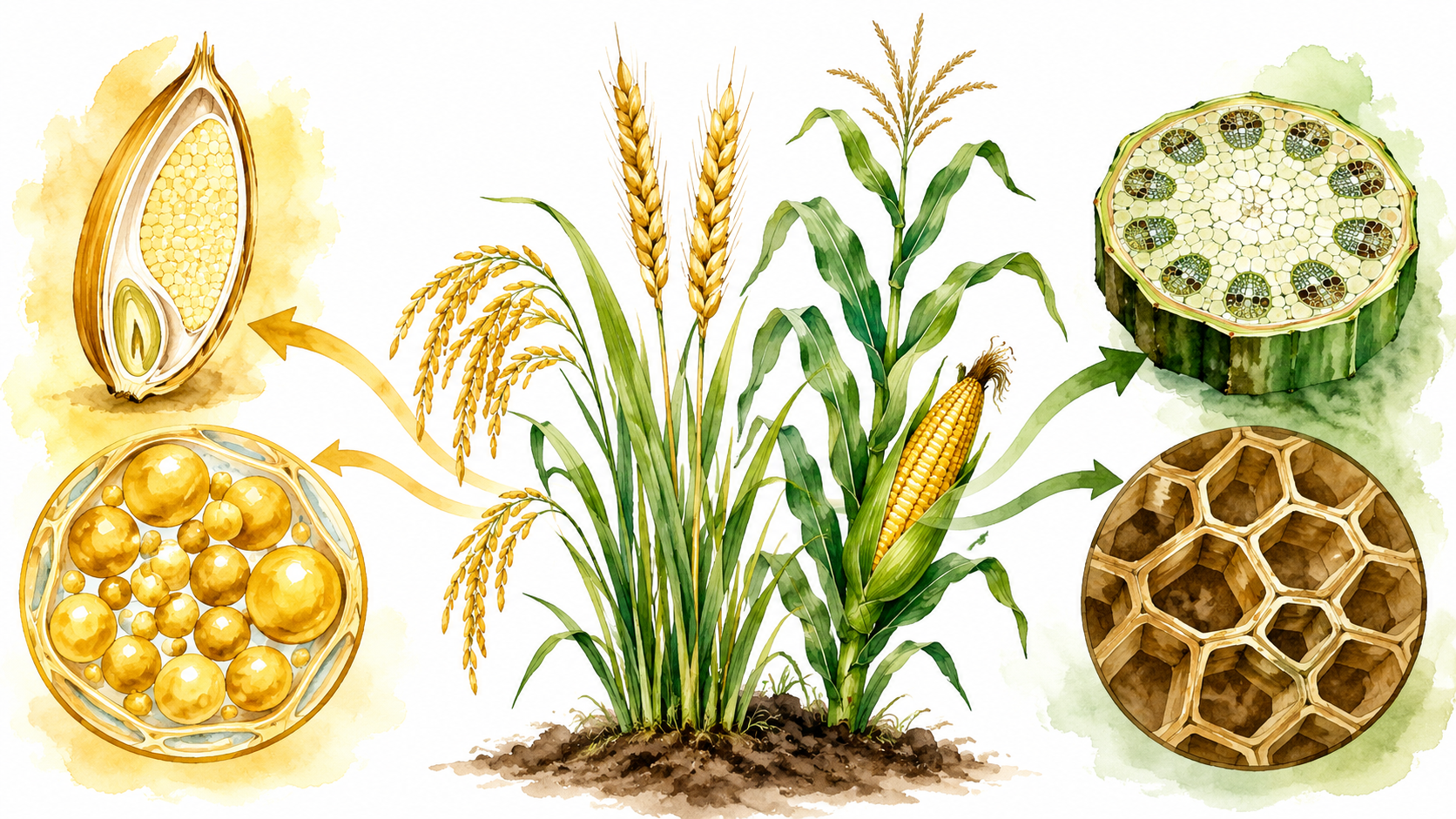
Rice, wheat, maize, barley, sugarcane, bamboo—grasses are central to both human food systems and many of the world’s ecosystems. But what did the grass lineage acquire during evolution that made its biology so distinctive?
A study published in Science on August 20, 2026 compared grass genomes with those of close relatives to reconstruct the origins of two major metabolic innovations: a distinctive route for starch biosynthesis and a second entry point into lignin-related phenylpropanoid metabolism.
The paper does not show that one pathway or one gene ‘caused’ the global success of grasses. Instead, it reveals a broader evolutionary pattern: gene duplication created spare copies of existing biochemical machinery, and those copies were gradually repurposed for new cellular locations and new substrates.
- Looking beyond grasses themselves
- Whole-genome duplication helped reshape starch metabolism
- Lignin metabolism contains a true biochemical shortcut
- Two amino-acid substitutions can push PAL toward PTAL activity
- This study does not prove why grasses became globally dominant
- Evolutionary reconstruction can inform crop engineering
- Summary
- Reference
Looking beyond grasses themselves
The researchers did not compare only modern cereal crops. They sequenced and analyzed genomes from the non-core grass Pharus latifolius, the non-grass graminids Joinvillea ascendens and Ecdeiocolea monostachya, and the more distantly related Typha latifolia.
By stepping outward along the evolutionary tree, the team could ask whether a metabolic feature appeared after the grass family emerged or whether it had already begun to evolve in the lineage immediately preceding grasses.
The answer was different for starch and lignin.
Whole-genome duplication helped reshape starch metabolism
In many plants, ADP-glucose—the activated sugar used for starch synthesis—is produced mainly inside plastids. Grass endosperm is unusual because it also produces ADP-glucose in the cytosol and then transports it into plastids for starch synthesis.
That compartmentalized pathway is particularly relevant to cereal grains, which accumulate large amounts of starch in their endosperm.
The comparative genomic analysis indicates that the rho (ρ) whole-genome duplication in the lineage leading to the common ancestor of grasses contributed to expansions of gene families underlying cytosolic starch biosynthesis.
Whole-genome duplication copies an entire genome at once. One copy of a duplicated gene can preserve the ancestral function while another is free to change its expression pattern, localization, or biochemical role.
In this case, grass starch metabolism appears to illustrate a classic evolutionary strategy: duplicate the existing parts, then redeploy some of them in a different cellular compartment.
Lignin metabolism contains a true biochemical shortcut
The second innovation concerns lignin and the broader phenylpropanoid pathway.
In the canonical route used by most vascular plants, phenylalanine is converted by PAL into cinnamic acid, and C4H then converts cinnamic acid into p-coumaric acid. This metabolite feeds downstream pathways that include lignin biosynthesis.
Grasses also possess a parallel route using PTAL, phenylalanine/tyrosine ammonia-lyase. PTAL can convert tyrosine directly into p-coumaric acid.
In simplified form:
Phenylalanine → PAL → cinnamic acid → C4H → p-coumaric acid
versus
Tyrosine → PTAL → p-coumaric acid
The second route is therefore a genuine metabolic shortcut into the same important intermediate.
The new study places the origin of PTAL before the emergence of the grass family itself. An earlier tandem duplication of a PAL gene produced the lineage from which PTAL evolved, meaning that a second entry point into lignin-related metabolism was already being assembled in close relatives of grasses before grasses fully emerged.
Two amino-acid substitutions can push PAL toward PTAL activity
One of the most striking parts of the study is that the authors experimentally reconstructed part of this functional transition.
Using PAL from Joinvillea ascendens, they introduced amino-acid substitutions suggested by evolutionary and structural analyses. Combining S112I and F140H strongly increased the enzyme’s ability to use tyrosine, shifting a primarily phenylalanine-using PAL toward the bifunctional behavior of PTAL.
Equivalent substitutions in the distantly related Arabidopsis PAL1 also greatly changed its affinity for tyrosine.
This does not mean that an entire metabolic pathway appeared from only two mutations. Gene duplication, regulation, metabolic context, and subsequent evolutionary changes all matter. But it does show that a major change in substrate preference can arise from a remarkably small number of amino-acid substitutions.
This study does not prove why grasses became globally dominant
The title question needs an important qualification.
The Science paper does not experimentally demonstrate that rho whole-genome duplication or the PTAL pathway directly caused grasses to become ecologically and agriculturally successful. Grass success reflects many traits, including photosynthetic strategies, growth architecture, meristem placement, root systems, responses to drought and fire, and interactions with animals.
What this study does show is that two characteristic metabolic systems of grasses were assembled through different forms of gene duplication.
A pathway supporting extensive starch accumulation arose in part through whole-genome duplication and subsequent gene-family diversification, whereas a second route into lignin metabolism arose from a more local PAL duplication followed by functional divergence.
Rather than appearing all at once, the metabolic foundation of grasses was assembled step by step.
Evolutionary reconstruction can inform crop engineering
The study is not only about reconstructing the past.
Knowing which duplicated genes enabled cytosolic starch biosynthesis, and which amino-acid residues altered PAL/PTAL substrate specificity, provides mechanistic information that could eventually be useful for engineering starch accumulation or cell-wall metabolism.
Lignin is especially important because it influences forage digestibility, paper production, biofuel processing, and broader biomass utilization.
Understanding how evolution created an alternative biochemical route can help identify which parts of plant metabolism are flexible enough to redesign.
Summary
The Science study reveals two different evolutionary routes to metabolic innovation in grasses:
- The expansion of cytosolic starch biosynthesis was associated with the rho whole-genome duplication in the lineage leading to the common ancestor of grasses.
- The second entry route into lignin metabolism, mediated by PTAL, traces back to an earlier tandem duplication of PAL.
- Two substitutions, S112I and F140H, were sufficient to give a PAL enzyme much stronger tyrosine-utilizing activity and move it toward PTAL-like behavior.
Evolution often does not invent a system from nothing. It copies an existing part, modifies it, and redeploys it.
Grass starch and lignin metabolism provide an unusually clear example of that principle.
Reference
Takeda-Kimura Y, Moore B, Holden S, et al. Genomes of Poaceae relatives reveal key metabolic innovations preceding the evolution of grasses. Science. 2026;393:778. DOI: 10.1126/science.adv0443.


Comments